- Multiplexing and Demultiplexing
- 1. Introduction
- 2. Frequency Division Multiplexing (FDM)
- [[#2. Frequency Division Multiplexing (FDM)#Definition|Definition]]
- [[#2. Frequency Division Multiplexing (FDM)#How It Works|How It Works]]
- [[#2. Frequency Division Multiplexing (FDM)#Example|Example]]
- [[#2. Frequency Division Multiplexing (FDM)#Advantages|Advantages]]
- [[#2. Frequency Division Multiplexing (FDM)#Disadvantages|Disadvantages]]
- 3. Wavelength Division Multiplexing (WDM)
- [[#3. Wavelength Division Multiplexing (WDM)#Definition|Definition]]
- [[#3. Wavelength Division Multiplexing (WDM)#How It Works|How It Works]]
- [[#3. Wavelength Division Multiplexing (WDM)#Example|Example]]
- [[#3. Wavelength Division Multiplexing (WDM)#Advantages|Advantages]]
- [[#3. Wavelength Division Multiplexing (WDM)#Disadvantages|Disadvantages]]
- 4. Time Division Multiplexing (TDM)
- [[#4. Time Division Multiplexing (TDM)#Definition|Definition]]
- [[#4. Time Division Multiplexing (TDM)#How It Works|How It Works]]
- [[#4. Time Division Multiplexing (TDM)#Types of TDM|Types of TDM]]
- [[#Types of TDM#1. Synchronous TDM|1. Synchronous TDM]]
- [[#Types of TDM#2. Asynchronous (Statistical) TDM|2. Asynchronous (Statistical) TDM]]
- [[#4. Time Division Multiplexing (TDM)#Example|Example]]
- [[#4. Time Division Multiplexing (TDM)#Advantages|Advantages]]
- [[#4. Time Division Multiplexing (TDM)#Disadvantages|Disadvantages]]
- 5. Comparison Table
Multiplexing and Demultiplexing
1. Introduction
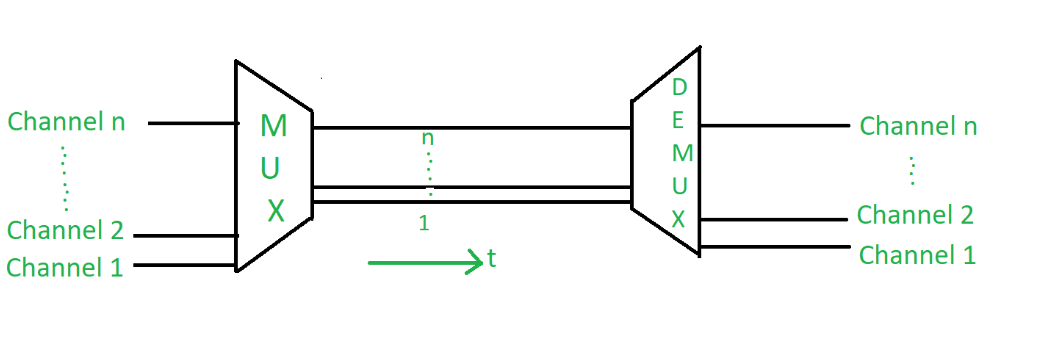
Multiplexing is a technique that allows multiple signals to share a single transmission medium, increasing efficiency and reducing costs. The reverse process, demultiplexing, separates these combined signals at the receiver end.
Applications of Multiplexing:
- Telecommunications – Multiple phone calls over one fiber optic cable.
- Broadcasting – Radio and TV signals transmitted on different frequencies.
- Computer Networks – Multiple data streams over a single communication link.
There are three main types of multiplexing: FDM (Frequency Division Multiplexing), WDM (Wavelength Division Multiplexing), and TDM (Time Division Multiplexing).
2. Frequency Division Multiplexing (FDM)
Definition
- FDM assigns different frequency bands to multiple signals, allowing them to be transmitted simultaneously over the same medium.
- Each signal is modulated onto a separate frequency within a shared bandwidth.
How It Works
- Multiple signals are modulated to different frequency ranges.
- These signals are combined and transmitted over a single communication channel.
- At the receiver end, a demultiplexer (Demux) separates them using bandpass filters.
Example
- FM Radio:
- Radio stations operate at different frequencies (88 MHz – 108 MHz).
- A receiver tunes in to a specific frequency (e.g., 101.1 MHz for a music station).
Advantages
✔ Efficient for analog signals.
✔ Supports continuous data transmission.
Disadvantages
✘ Requires large bandwidth.
✘ Interference (crosstalk) may occur between frequency bands.
3. Wavelength Division Multiplexing (WDM)
Definition
- WDM is a specialized form of FDM used in fiber optic communication.
- Instead of different frequencies, it uses different light wavelengths (colors) in a single optical fiber.
How It Works
- Multiple laser beams of different wavelengths (colors) are combined into a single optical fiber.
- A WDM multiplexer merges these signals for transmission.
- At the receiver end, a demultiplexer separates signals based on wavelength.
Example
- Fiber Optic Networks:
- Dense Wavelength Division Multiplexing (DWDM) allows hundreds of light signals in a single fiber.
- Used in high-speed internet backbones and submarine cables.
Advantages
✔ High data capacity over long distances.
✔ Minimal interference since light waves do not overlap.
Disadvantages
✘ Requires expensive optical components (lasers, filters, multiplexers).
✘ Complex installation and maintenance.
4. Time Division Multiplexing (TDM)
Definition
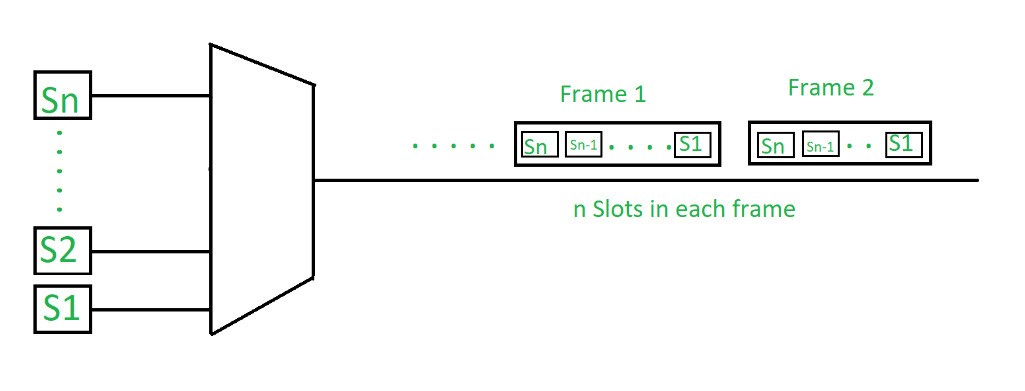
- TDM allocates time slots to different signals on a shared channel.
- Each user gets a fixed time interval to transmit data.
How It Works
- The available channel is divided into time slots.
- Each sender transmits data in its assigned time slot.
- The receiver extracts data by reading slots in sequence.
Types of TDM
1. Synchronous TDM
- Each user gets an equal time slot, even if no data is available.
- Example: Old telephone networks (T1, E1 lines).
2. Asynchronous (Statistical) TDM
- Time slots are assigned dynamically based on demand.
- Example: Modern digital networks (Ethernet, DSL, LTE).
Example
- Computer Networks:
- In Ethernet, multiple users send data using time-sharing mechanisms.
- In 4G/5G, time slots dynamically adjust based on traffic.
Advantages
✔ Efficient for digital transmission.
✔ No frequency interference like in FDM.
Disadvantages
✘ Delay in data transmission if time slots are not optimized.
✘ Unused time slots waste bandwidth in Synchronous TDM.
5. Comparison Table
| Feature | FDM | WDM | TDM |
|---|---|---|---|
| Technique | Frequency-based | Wavelength-based | Time-based |
| Used in | Analog systems (Radio, TV) | Fiber optics | Digital systems (Networks, Telephony) |
| Interference | Yes (adjacent frequency overlap) | No (light waves do not interfere) | No (time slots are separate) |
| Efficiency | High for continuous signals | Best for high-speed fiber networks | High for digital communication |
| Cost | Moderate | High (expensive optical equipment) | Low |
6. Summary
- Multiplexing improves channel utilization by allowing multiple signals on a single medium.
- FDM uses different frequency bands (e.g., FM radio, TV broadcasting).
- WDM uses different light wavelengths in fiber optics.
- TDM assigns time slots for digital data transmission (used in networks and telephony).
Would you like examples of real-world implementations of these multiplexing techniques?