INDEX
- QUE 1)Explain various types of database models.==
- QUE 2) Write E-R diagram notation with example.==
- QUE 3)Explain Codd’s rules.==
- QUE 4)Explain transaction scheduling with scheduling operations==
- QUE 5)What is need of normalization. Define first Normal form, Second Normal form and Third Normal form with==
- [[#QUE 5)What is need of normalization. Define first Normal form, Second Normal form and Third Normal form with==#Why Do We Need Normalization?|Why Do We Need Normalization?]]
- [[#QUE 5)What is need of normalization. Define first Normal form, Second Normal form and Third Normal form with==#First Normal Form (1NF)|First Normal Form (1NF)]]
- [[#QUE 5)What is need of normalization. Define first Normal form, Second Normal form and Third Normal form with==#Second Normal Form (2NF)|Second Normal Form (2NF)]]
- [[#QUE 5)What is need of normalization. Define first Normal form, Second Normal form and Third Normal form with==#Third Normal Form (3NF)|Third Normal Form (3NF)]]
- QUE 6)Write Short notes on ANY THREE
- [[#QUE 6)Write Short notes on ANY THREE#a) Properties of Transaction|a) Properties of Transaction]]
- [[#QUE 6)Write Short notes on ANY THREE#b) Deadlock|b) Deadlock]]
- [[#QUE 6)Write Short notes on ANY THREE#c) Characteristics of Database|c) Characteristics of Database]]
- [[#QUE 6)Write Short notes on ANY THREE#d) Shadow Paging|d) Shadow Paging]]
- QUE 7)Explain types of failure in database system==
- QUE 8)Draw E-R diagram for College Management System
QUE 1)Explain various types of database models.==
ANS:
Certainly! Let’s explore various types of database models:
-
Hierarchical Database Model:
- Structure: Tree-like structure with parent-child relationships.
- Representation: Each record has a single parent, except for the root record.
- Example: An organizational chart where employees report to managers.
-
Network Database Model:
- Structure: Graph-like structure with interconnected records.
- Representation: Records can have multiple parents (owners).
- Example: A university course registration system with students and instructors.
-
Relational Database Model:
- Structure: Table-based format with rows and columns.
- Representation: Data stored in tables (relations) with keys linking them.
- Example: An employee database with tables for employees, departments, and projects.
-
Object-Oriented Database Model:
- Structure: Object-based format with classes and objects.
- Representation: Data stored as objects with attributes and methods.
- Example: Storing multimedia content (images, videos) with associated metadata.
-
Object-Relational Database Model (ORDBMS):
- Structure: Hybrid format combining relational and object-oriented features.
- Representation: Extends relational databases to handle complex data types.
- Example: Storing customer orders with details and associated products.
-
Entity-Relationship (ER) Model:
- Structure: Conceptual design tool using entities, relationships, and attributes.
- Representation: Describes data requirements and relationships.
- Example: Designing a university database with students, courses, and instructors.
-
Other Database Models:
- Document Model: Stores data in documents (e.g., JSON, XxML).
- NoSQL Model: Flexible schema for unstructured or semi-structured data.
Each model serves specific purposes and caters to different data complexities. Choosing the right model depends on the application requirements and data characteristics! 🗂️🔍
QUE 2) Write E-R diagram notation with example.==
ANS:
Certainly! Let’s explore the notation used in an Entity-Relationship (ER) diagram along with an example:
-
ER Diagram Notation:
- Entities: Represented by rectangles.
- Attributes: Represented by ellipses (ovals) inside the entity rectangles.
- Relationships: Represented by diamonds connecting entities.
- Lines: Connect attributes to entities and show relationships.
- Primary Key: Underlined attribute within an entity.
- Foreign Key: Attribute referencing another entity’s primary key.
-
Example ER Diagram: Consider a simple library database with the following entities:
-
Entities:
- Book: Contains attributes like
ISBN,Title, andAuthor. - Author: Contains attributes like
AuthorID,Name, andBirthYear. - Borrower: Contains attributes like
BorrowerID,Name, andContact.
- Book: Contains attributes like
-
Relationships:
- Borrowed By: Connects
BookandBorrower. Represents which book is borrowed by which borrower. - Written By: Connects
BookandAuthor. Represents which author wrote which book.
- Borrowed By: Connects
Here’s a simplified ER diagram for this library database:
In this diagram:
BookandAuthorare entities.ISBN,Title,AuthorID, etc., are attributes.Borrowed ByandWritten Byare relationships.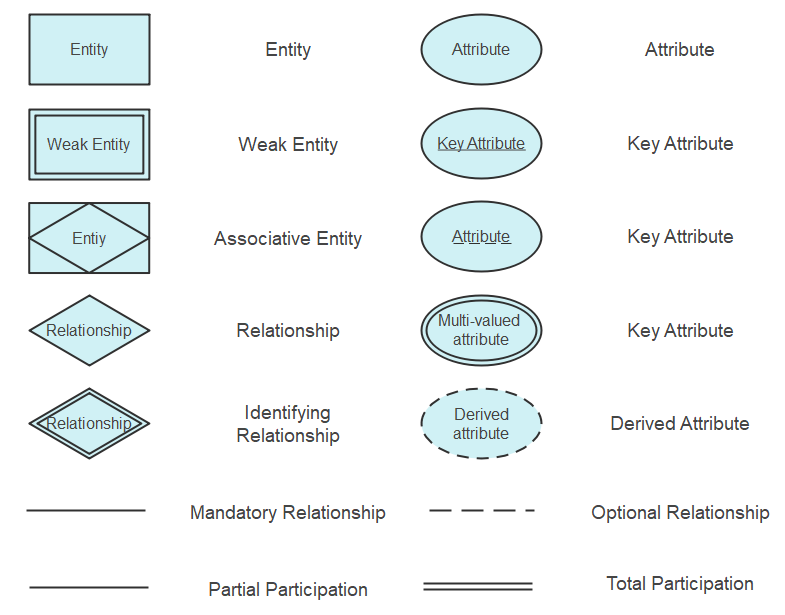
-
Remember that ER diagrams help visualize the structure of a database, making it easier to design and understand relationships between entities! 📊🔍
QUE 3)Explain Codd’s rules.==
ANS:
Codd’s Rules are a set of guidelines proposed by Dr. Edgar F. Codd, the inventor of the relational model for databases. These rules define the characteristics and requirements of a Relational Database Management System (RDBMS). Let’s explore these rules:
-
The Information Rule:
- All information, whether user data or metadata, must be stored in a database as a value within a cell of a table.
- Everything within the database is organized in a table layout.
-
The Guaranteed Access Rule:
- Each data element (attribute) is guaranteed to be logically accessible using a combination of the table name, primary key (row value), and attribute name (column value).
-
Systematic Treatment of NULL Values:
- Every NULL value in a database must receive a systematic and uniform treatment.
- NULLs should not lead to ambiguity or inconsistency.
-
Active Online Catalog Rule:
- The database catalog (metadata about the database) must be stored and accessed using the same RDBMS.
- Catalog information should be part of the database itself.
-
The Comprehensive Data Sublanguage Rule:
- A database system must provide an easily understandable Data Manipulation Language (DML) for defining, querying, and modifying data.
- Users interact with the database using this language.
-
The View Updating Rule:
- All theoretically updatable views (derived tables) must also be updatable by the system.
- Views should allow modifications if they represent valid data subsets.
-
High-level Insert, Update, and Delete:
- The database system should facilitate high-level insertions, updates, and deletions.
- Users can perform these operations through a single query.
-
Physical Data Independence:
- Application programs should remain unaffected when changes are made to the physical storage structures or methods.
- Logical changes should not impact application code.
-
Logical Data Independence:
- Application programs should remain unaffected when changes are made to the logical structure of the data (e.g., adding or modifying tables).
- Logical changes should not require code modifications.
-
Integrity Independence:
- Integrity constraints (such as unique keys, foreign keys) should be specified separately from application programs.
- The database system should automatically enforce these constraints.
-
Distribution Independence:
- The distribution of data across multiple locations should be invisible to users.
- The database system should handle distribution transparently.
-
Non-Subversion Rule:
- If the system provides access to low-level records, the interface must not bypass security and integrity constraints.
- Users should not be able to damage the system through low-level access.
These rules ensure data integrity, consistency, and usability in a relational database system. Following Codd’s rules leads to a true RDBMS! 🛢️🔍
QUE 4)Explain transaction scheduling with scheduling operations==
ANS:
Transaction Scheduling in Databases
In the context of databases, transaction scheduling refers to the orderly execution of multiple transactions. When several transactions run concurrently, their operations need to be timed and ordered to prevent conflicts and ensure data consistency. Let’s explore the different types of schedules:
-
Serial Schedules:
-
In a serial schedule, transactions execute non-interleaved (one after the other).
-
No transaction starts until the previous one has completed.
-
Example:
T1: R(A) W(A) R(B) W(B)
T2: R(A) R(B)
Here, T1 and T2 execute serially.
-
-
Non-Serial Schedules:
- Operations of multiple transactions are interleaved.
- Transactions proceed without waiting for others to complete.
- Non-serial schedules can be:
- Serializable: Equivalent to a serial schedule (no overlapping transactions).
- Conflict Serializable: Can be transformed into a serial schedule by swapping non-conflicting operations.
- View Serializable: View equal to a serial schedule (no overlapping transactions).
- Non-Serializable: Interleaved operations without violating consistency.
- Maintains correctness but lacks the benefits of concurrency.
- Serializable: Equivalent to a serial schedule (no overlapping transactions).
-
Conflict and View Serializable Schedules:
- Conflict Serializable:
- Operations can be reordered without affecting correctness.
- Conflicting operations involve different transactions on the same data item.
- View Serializable:
- Equivalent to a serial schedule in terms of visible results.
- No overlapping transactions.
- Conflict Serializable:
-
Resource Utilization and CPU Throughput:
- Serializable schedules improve both resource utilization and CPU throughput.
- Non-serial schedules sacrifice concurrency for correctness.
In summary, transaction scheduling ensures proper execution order, consistency, and integrity in a database system. Choosing the right type of schedule depends on the specific requirements and trade-offs. 🛢️🔍
QUE 5)What is need of normalization. Define first Normal form, Second Normal form and Third Normal form with==
ANS:
Certainly! Let’s dive into the world of database normalization and explore the need for it, along with definitions of the first, second, and third normal forms (1NF, 2NF, and 3NF).
Why Do We Need Normalization?
Normalization is a crucial process in database design. Here’s why we need it:
-
Eliminating Redundancy:
- Redundant data wastes storage space and complicates data management.
- Normalization helps remove duplicate information, ensuring efficient storage.
-
Data Consistency:
- Inconsistent data can lead to incorrect results and reporting.
- Normalization ensures that data remains consistent across the database.
-
Avoiding Anomalies:
- Without normalization, we encounter anomalies during data manipulation (insertion, update, deletion).
- Normalization minimizes these anomalies.
-
Simplifying Queries:
- Normalized data allows for simpler and more efficient queries.
- Complex queries become easier to write and maintain.
Now, let’s delve into the definitions of the three normal forms:
First Normal Form (1NF)
- Ensures that each attribute (column) in a relation (table) contains only atomic (indivisible) values.
- No repeating groups or multi-valued attributes.
- Example: A table with single-valued attributes and a unique name for every column.
Second Normal Form (2NF)
- Applies to relations with composite keys (primary keys composed of multiple attributes).
- Eliminates partial dependencies (where non-prime attributes depend on a proper subset of the candidate key).
- Ensures that every non-primary-key attribute is fully functionally dependent on the primary key.
Third Normal Form (3NF)
- Eliminates transitive dependencies (where non-prime attributes depend on other non-primary-key attributes).
- Ensures that no non-primary-key attribute is transitively dependent on the primary key.
- Improves data integrity and organization.
Remember, achieving 3NF is considered good practice for relational databases, as it reduces anomalies and ensures data correctness. 🛢️🔍
QUE 6)Write Short notes on ANY THREE
==
a)Properties of transaction
b) Deadlock
c) Characteristics of database
d) Shadow Paging
ANS:
Certainly! Let’s explore the requested topics:
a) Properties of Transaction
-
Atomicity:
- Ensures that either all operations of a transaction are executed or none at all.
- Transactions are treated as a single unit, and they either complete successfully (commit) or are aborted (rollback).
- Example: Money transfer from one account to another—either both accounts are updated, or neither is.
-
Consistency:
- Maintains the integrity of the database.
- Transactions transform the database from one consistent state to another.
- Integrity constraints are enforced to ensure correctness.
- Example: Total balance before and after a transaction remains the same.
-
Isolation:
- Ensures that concurrent transactions do not interfere with each other.
- Transactions execute independently without affecting others.
- Concurrency control mechanisms enforce isolation.
- Example: Transaction T1 accessing data does not allow T2 to modify the same data simultaneously.
-
Durability:
- Guarantees that committed changes persist even after system failures.
- Once a transaction commits, its effects are permanent.
- Recovery subsystem ensures durability.
- Example: After a successful money transfer, the system ensures the data is not lost.
b) Deadlock
- Deadlock occurs when two or more transactions are waiting indefinitely for each other to release resources (e.g., locks) they need to complete their operations.
- Transactions are stuck, unable to proceed, leading to a system standstill.
- Techniques to handle deadlocks include timeout mechanisms, deadlock detection algorithms, and careful transaction design.
c) Characteristics of Database
-
Real-World Entity:
- Databases model real-world entities (e.g., students, products).
- Structured data representation with attributes (e.g., name, age).
-
Self-Explaining Nature:
- Metadata (data about data) explains the database structure.
- Tables, rows, and relationships are self-descriptive.
-
Atomicity of Operations:
- Transactions are either fully executed or not executed at all.
- Ensures consistency and correctness.
d) Shadow Paging
- Shadow Paging:
- Recovery technique for databases.
- Considers the database as fixed-size logical pages mapped to physical blocks.
- Uses two page tables: current page table (modifiable) and shadow page table (unchanged).
- Ensures atomicity during transaction execution and recovery.
- Minimizes disk accesses and provides fault tolerance.
Feel free to ask if you need further clarification on any of these topics! 🛢️🔍
QUE 7)Explain types of failure in database system==
ANS:
Certainly! Let’s explore the different types of failures in a database system:
-
Transaction Failure:
- Occurs when a transaction cannot complete successfully.
- Reasons for transaction failure include:
- Logical errors: Code or internal error prevents transaction completion.
- Syntax errors: The DBMS terminates an active transaction due to unexecutable conditions (e.g., deadlock).
- Handling transaction failures is crucial for maintaining data consistency.
-
System Crash:
- A system crash occurs due to hardware or software failures.
- Examples:
- Operating system errors.
- Power failures.
- Fail-stop assumption: Non-volatile storage (disk) remains intact.
-
Disk Failure:
- Hard disk drives or storage drives may fail.
- Causes include bad sectors, disk head crashes, or unreachability.
- Disk failure destroys part or all of the disk storage.
- Modern systems use redundancy (RAID) to mitigate disk failures.
-
Communication Line Failure:
- Network or communication line disruptions.
- Data transmission errors or network outages.
- Distributed databases are vulnerable to communication failures.
Handling these failures involves techniques such as backup, recovery, redundancy, and fault tolerance. 🛢️🔍
QUE 8)Draw E-R diagram for College Management System
ANS:
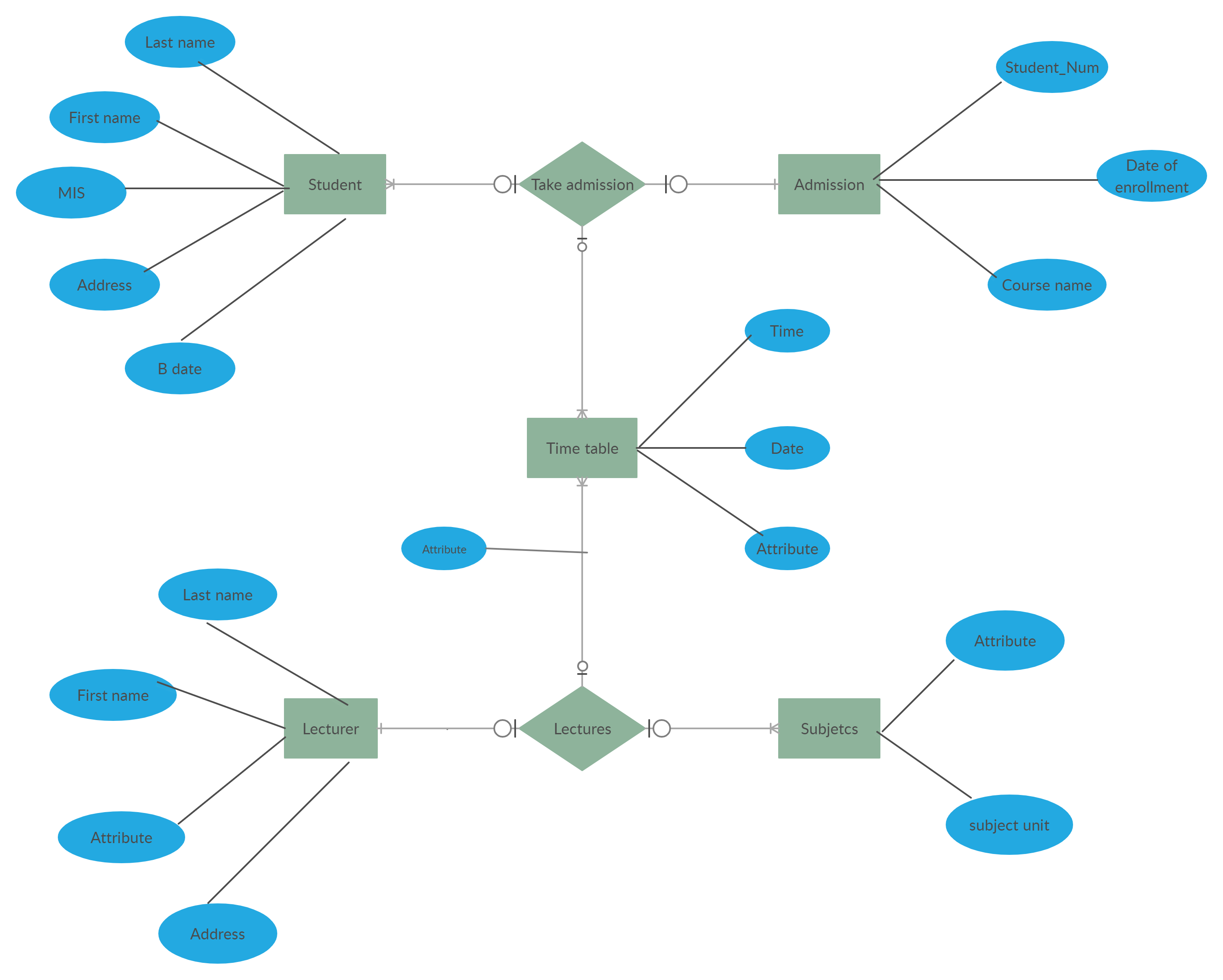
Certainly! Here’s a simplified Entity-Relationship (ER) diagram for a College Management System:
In this diagram:
-
Entities:
- Student: Contains attributes like
StudentID,Name, andDOB. - Course: Contains attributes like
CourseID,Title, andCredits. - Professor: Contains attributes like
ProfessorID,Name, andDepartment. - Department: Contains attributes like
DepartmentID,Name, andLocation.
- Student: Contains attributes like
-
Relationships:
- Enrolls In: Connects
StudentandCourse. Represents which student is enrolled in which course. - Teaches: Connects
ProfessorandCourse. Represents which professor teaches which course. - Works In: Connects
ProfessorandDepartment. Represents which professor works in which department.
- Enrolls In: Connects
This ER diagram captures the essential relationships between students, courses, professors, and departments in a college management system. 📊🔍